Thursday, February 21, 2013

Seafood Fraud in the News


I wanted to share an article released today by Oceana on seafood fraud.  The reports are a little disturbing.  CNN is also airing a report on the subject today.  From the report you can see that mislabeling is happening nationwide and it is a problem that needs a bigger bandaid.  There are many different cases and situations, but frankly customers deserve to know what they are eating.  Whatever we have to do to accomplish this, we need to do it, and enforce it.  BRG is teaming up with Congressional Seafood, one of its suppliers, and beginning a traceability program for its restaurant's menus.  This is just one step we are taking to ensure that we are getting the fish that we pay for, and in turn, our customers are certain that when they come to our restaurants they are served exactly what is stated on the menu.  Remember that when you go bargain shopping for your seafood, you might not be getting the deal you bargained for.  You can view the article here and here.


Tuesday, February 19, 2013

Norway Delivers Beautiful Crab

The fresh king crab season for Alaska lasts about three weeks from October until the quota is hit.  That doesn't give us much time to enjoy one of nature's tastiest, most sustainable seafood items.  You can get frozen king crab just about anywhere, but enjoying right off the boat fresh is something only about 5% of the population gets to enjoy.  Truly, it's an experience meant for a king, no pun intended.  Insert Norway here.


The Norwegians are now producing a fresh, never frozen king crab that equals it's Alaskan counterpart in quality and flavor.  Pinnacle Seafood processes king crab on the coast of Finnmark, Norway live, fresh and frozen and delivers to the States the very same day.  The crabs are caught by day-boat off of the coast of Norway and the fishery is supported by the World Wildlife Fund and Greenpeace.  The legs yield about 90% meat.  This means that when you break into a juicy leg, your reward is a fat, buttery, mouth-watering chunk of crabmeat.  BlackSalt is carrying the fresh, never frozen product while demand lasts.  The flavor is unequaled in my opinion, fresh king crab just may be the most delicious seafood item out there.  There is no need for sauces or cooking.  Just purchase a cluster, crack open a leg, and let your mouth experience the fresh ocean goodness.  King crab is rich and fatty, so you don't need a ton to get your fill, but on the other hand it won't leave you feeling like you just ate a Buick.  I recommend them at room temperature and naked.  I liken the experience to tasting an ocean truffle; it's rich, smooth, balanced with salt and fat, and induces a crescendo of delight that resets your taste buds and makes you rethink all of your previous food experiences.

Friday, February 8, 2013

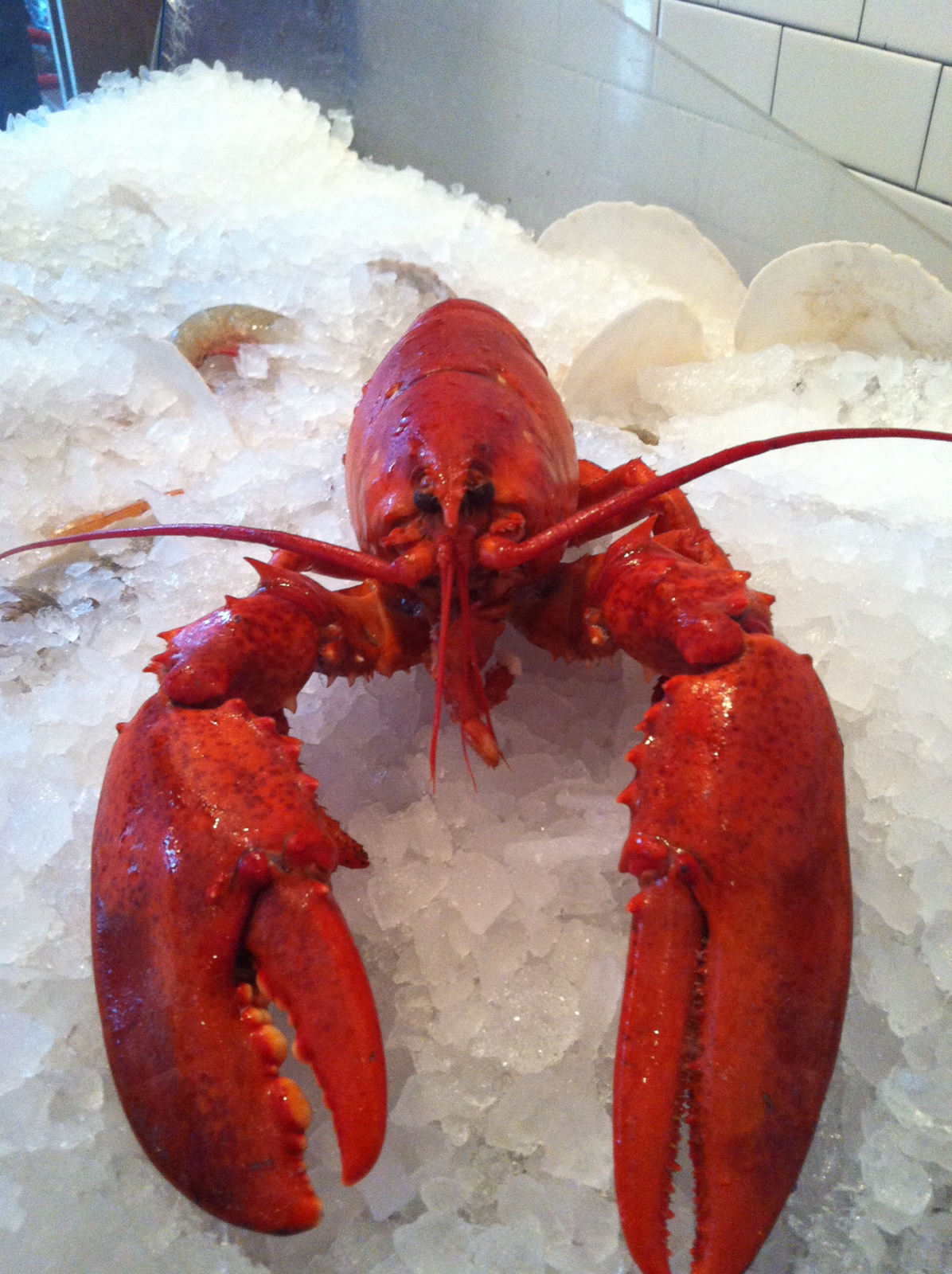
Valentine's Day, So You're Gonna Need a Lobster

If you have a 'someone special' then listen up, Valentine's Day is next Thursday.  If you don't have a special someone, but would like one, its also best to pay attention.  Behind New Year's Eve, Valentine's Day is one of the busiest days for restaurants across the country.  Tables get booked weeks in advance and usually for the restaurant staff the day goes by in a blur of commotion and execution as table after table is turned, until finally everyone tiredly makes their way home.  It's nice because you feel as though you were a part of someone's love story, but at the same time it's quite a daunting feat to welcome 200 people in 2 hours.  Couples visiting restaurants encounter and become a part of the same madness.  Booking a reservation and making it to the restaurant on time are two different things, with everyone going out, traffic can be brutal.

 It's always fun to be in a crowd and everybody loves a scene.  But if seclusion and privacy is your thing, you are best off preparing a quiet, romantic meal for two at home.  For it to be special I recommend staying away from the chicken and steak, besides no one wants feel like they just ate a ton of bricks, especially if you have after dinner plans - like dancing.  From my experience, for no known reason, nothing says 'I love you', or 'I like you', or 'you're pretty ok' like lobster.  Tried and true, every Valentine's Day I see more and more lobsters being sold through the market.  Some do it every year.  Some have never done it before.  Usually those are the ones with a lot of questions and even more trepidation.  One thing is certain though, everyone returns happy and amazed at how easy and delicious live lobster can be to prepare.  Here's a quick guide to preparing your love bugs at home. ('Bugs' is another name for lobsters - seriously, ask anybody north of New York)

It's best to buy your bugs live and ask for hardshells.  Hardshells are lobsters that have not recently shed their outer skin and usually pack more meat than the softer shelled lobsters.  Now remember they don't turn that bright red until you cook them, so when you greet your guy it'll look a lot darker.
 I feel like 1 1/2lb lobsters are the perfect size for one, but I do recommend bigger eaters going for the 2lbers.  That sounds like too much, but remember a pound of lobster will only yield you about a quarter pound of meat.  What is gratifying is that lobster meat is very rich and good for you, so a little goes a long way, though it won't weigh you down like other non-seafood proteins.  The easiest way to cook your lobster is to boil it in flavored water.  I usually use black peppercorn, salt, lemon, and bay leaves, but feel free to add your own spices to your liking.  Submerge two 1 1/2lb lobsters after the water comes to a boil and 12 to 15 minutes later you are adding butter to the meat and serving.  Really it's that easy.  If you want to steam them just use less water, still season it, and add on about 10 minutes of cooking time.  Lobster meat when done will be white.  If you get a female you may find coral, when cooked it's red and raw it's green.  Don't shy away from it, it can be quite tasty.  You can crack the claws with the back of a chef's knife.  Just turn the claw on it's side and strike.   Twist the knife handle to split the claw.  It's easier to do this if you remove the rubber bands and moveable appendage of the claw first.  There is great meat in the knuckle area of the arm, so be sure to crack those too.  Use the knife to split the back of the tail to extract the meat.  Here is where the drawn butter comes in.

With a simple internet search you can find other recipes for lobster.  Some of my favorites include lobster pot pie, lobster poached in butter, and lobster salad.  Most markets will sell you lobster meat, just make sure it is fresh cooked and never frozen.  Preparing the lobsters yourself is always the better solution in my opinion, you can't get it any fresher than out of your own pot.  You shouldn't feel any pity for the lobsters either, after all they're just bugs, delicious bugs, but bugs all the same.  Lobsters have an underdeveloped nervous system, so their pain receptors are nothing like a humans.  Lobsters can lose an appendage in the wild and not miss a beat.  Usually the arm will grow back like nothing happened.  So if you are looking to avoid the whole Valentine's shuffle and do some entertaining of your own in the comfort of your home, I am recommending the love bugs for your love bug.  It tastes like you've been in the kitchen all day, but it actually frees up your time for more important things - like that last minute Valentine's Day card you forgot to get.


Wednesday, February 6, 2013

Sea Lice in Ireland, Not a Problem?

The seafood business is ever evolving, ever changing.  Information gets updated, thrown away, revisited, proven and disproven on what seems like a weekly basis.  It's hard to keep up with what's fact and what was just yesterday's headline.  Adding to the confusion are the plethora of groups publishing 'facts' about what seafood is safe to eat, what is good for the environment and what is bad.  Bad press sells, especially when it comes to farmed seafood.  Oftentimes the public will take what is stated in print - be it over-zealous or questionably influenced - as the final answer.  With all the studies out there, the fact that the people publishing these articles are supported and influenced by outside parties with hidden agendas gets lost sometimes.  Whenever I research a seafood related subject, I try to glean information from as many reputable sources as I can.  I even read through some of the non-reputable sources, just to get the full picture.  I usually begin my search with government associated agencies, such as NOAA, and end with third party audits and those associated closely to the source, such as fishermen.

A recent article published in the Journal of Fish Diseases here , got me thinking about what is considered common knowledge, how it became that way, and what it means for the future of the seafood business.  The article presents a study done in Ireland by the Marine Institute that suggests sea lice infestation from salmon farms may not have as negative or encompassing effect on wild salmon stocks as was once thought.  Sea lice are marine parasites that occur naturally on many wild fish but are notoriously associated with salmon farms.  It is believed by many that the infestation of salmon farms by sea lice pose significant threats to surrounding wild salmon populations.  Just a few sea lice can kill young wild salmon fry.  If you do an Internet search for "sea lice and salmon farms" you will find that the two are associated with the mortality of wild salmon.  However, this recent study makes claims that previous investigations were flawed in their design and that what was once held as common knowledge, now, under closer scientific inspection, does not appear to be the truth.  The experiment highlighted in the article makes a claim that sea lice affect less than 1% of wild salmon stocks and are not a significant detriment to the wild salmon population in Ireland.  Norway did a similar study and found similar results.  

So, who do we believe? Who do we listen to?  Is this report a clearer view of what's happening?  Are sea lice in Canada responsible for the deaths of thousands of wild salmon and one of the major reasons wild salmon stocks there have declined?  The purpose of this post is not to answer that question, but to highlight the fact that common knowledge is not always the truth, it's just common.  That could be because previous studies were flawed or they were influenced by the private interests of invested parties, or the science was just outdated, in any case it's always important to question our sources and their motives.  So, I am just presenting another article that just happens to fly in the face of common beliefs shared by anti-farmed salmon lobbyists.  It's just another piece of this puzzle that we are trying to put together to get a clearer view of what it means to eat informed.      

Thursday, January 24, 2013

Don't Hold The Anchovies


You will not find anchovies listed on the Monterey Bay Aquarium's Seafood Watch and it is very hard to tie down a 'color', whether it be good (green) or bad (red), to the fishery.  Maybe its because the fishery has been known to fluctuate from year to year without any warning.  Maybe its because the fishery has collapsed in many places only to rebound with astounding productivity.  It is even difficult to talk about the anchovy 'fishery' because there are many different areas with differentiating populations, some healthy and some not so much.  Wherever they come from, anchovies make for a healthy, tasty meal, and are invaluable as a food source for other animals.  Most of the catch goes into making other items such as fish oil, fertilizers, and fish meal.  A smaller percentage of the catch is produced for human consumption, which is unfortunate because they really are one of the healthiest 'brain' foods you can eat.

Anchovies are low in mercury and other toxins that exist in the environment due to the fact that they eat very low on the food chain.  They are extremely good sources of omega-3's, calcium, iron, niacin, and the very important selenium.  Basically, the perfect protein.  Most options in the market are going to be fillets packed in vinegar or oil, but occasionally you will find fresh anchovies.  If these are available, jump on them.  There really is no fish out there that packs as much flavor as fresh anchovies.  They are great fried and eaten whole, head and all.  You have to trust me on this, its like eating a salty, savory explosion of ocean goodness.  If you are not so adventurous, try de-boning them with your fingers, the flesh is very delicate so you will not need a knife, and baking or panfrying them with butter and garlic, finishing with fresh herbs and lemon.  The canned and jarred varieties are great on salads and make great additions to sauces (worcestershire sauce is made from anchovies), or can be enjoyed on their own if they are of a high quality.  Just add some cheese and bread and you have a great snack or dinner.

Now that you are dying for some anchovies, lets talk about which fisheries you should be buying from. In 2005 the Bay of Biscay fishery collapsed, only to rebound and rethink their efforts in 2010.  Five years of patience resulted in a turnaround for the fishery and today the anchovy population is healthy and considered sustainable by the MSC.  Argentine anchovies are MSC certified, a good indicator that you are buying a sustainable product.  The Peruvian fishery is one of the largest fisheries in the world.  Water temperatures can result in down years and overfishing has been an issue in the past, but today the fishery is working towards sustainability and populations are stable.  It seems the Peruvians understand what an important resource they have.  Moroccan and Croatian anchovies are not MSC certified, but many independent audits such as Friends of the Sea list those fisheries as sustainable.  Our own North Atlantic and Pacific stocks are healthy and at sustainable levels according to NOAA and other audits.  By-catch is not a major issue for the anchovy fishery due to the fact that trawlers identify large shoals and target their intended species with minimum by-catch.

With educated eating comes healthy eating.  There are plenty of sources to choose from, so finding ocean friendly anchovies should not be an issue.  They are a super food, so there are no health concerns associated with eating anchovies.  So, what's holding you back from partaking in quite possibly the ultimate protein that millions of other fish feed on?  Millions of other fish can't be wrong, can they?  I am not advocating an all anchovy diet, we need to save some for our fish friends in the sea.  What I am advocating is the next time you try a caesar salad, don't be so quick to 'hold' the anchovies.  Julius knew what he was doing when he put them on there.

Wednesday, January 16, 2013

Scallops 101

The scallop market is about to take a big jump.  Word is that quotas are going to be cut up to 35% in some areas.  What this means is that it is going to get even harder to find high quality dry scallops.  What exactly a 'dry' scallop is, as opposed to divers, refresh, or treated, needs to be addressed first.

There are many different products at all kinds of prices available in the scallop market.  We at BlackSalt buy true dry scallops for our market and restaurants.  A dry scallop is a scallop that has never been frozen and has never been treated.  However, it is legal to sell a 'dry' scallop that has been treated with a saline solution and still call it 'dry' if it has been in the solution less than 24 hours.  The saline solution helps preserve the scallop and also adds water weight to the product.

We do not purchase these scallops at BlackSalt, but instead we look for true dry scallops only caught by day-boats like The Sea Ranger, whose captain is Ger Tonneson.  These scallops are landed in places like Maine and Massachusetts and come to us just hours out of the water.  What day-boat means is that these fishermen are allotted only so many pounds a day and once they hit that quota they return from the water with their harvest the same day that they set out.  This ensures that the scallops we purchase are the freshest product possible.  We pay a little more for this product, but we feel like the quality that is passed on to the customer is worth it.  When purchasing scallops that are labeled 'dry' it might be beneficial to ask whether there is a 24hr treatment on them, or just shop at BlackSalt where you don't have to ask.

Some scallops are packed treated or refreshed.  Treated scallops have a solution on them that increases shelf-life.  This is important for retailers, because the shelf-life on truly dry scallops is very short.  That is why rotation of product at our market is quick; truly dry scallops need to be fresh.  Other markets that sell treated scallops do not have to worry about turnover as much but, in my opinion, you can taste the difference.  A refreshed scallop is a product that has been frozen and then thawed.  Usually the flavor on these will be even less bright than treated or dry scallops and the color is usually a little grayish.  I can't in good faith recommend this product to anyone.  Truly dry scallops will have a fresh, sweet, ocean flavor without any lingering aftertaste.  A truly dry scallop will also give you a nice sear on a hot pan very quickly, where it takes a treated or 'dry' scallop a little longer to get that crispy brown, and in some cases it doesn't happen at all.

Sometimes you may see scallops that are pink or orange.  These to me taste the sweetest and should not be avoided.  The theory is that these scallops were females with red roe sacs.  The different color signals a sweeter scallop.  Stay away from scallops that appear gray, this is a sign of age and freezing.  Scallops naturally release gas so if you come across scallops that have been in a container and the first odor is of gas, do not send them packing into the garbage.  Give them a little air and time and that should go away.  When scallops smell sour or overly gassy, then its time to give up on them and look for new product.  Also, look to purchase scallops that are not broken and greasy.  Fresh scallops should be firm and a little tacky to the touch.

Wherever you decide to purchase scallops, make sure to check them out thoroughly and ask questions.  Scallops are always a good indicator of the quality of the market you are shopping in: the more questions that the fishmonger can answer and more pride they take in answering them, the better the market.

Wednesday, January 9, 2013

Copper Shoals keeps Red Drum Afloat

In the 70's and 80's the popularity of Paul Prudhomme's blackened redfish dish almost wiped out the native red drum from the coastal waters of Texas and Louisiana.  It was so popular that redfish, formally known as red drum, was listed as a protected species and during this time commercial sell was outlawed.  These restrictions have since eased due to the resurgence of red drum stocks, but it was aquaculture that really emerged as a winning solution to the tasty fish's high demand.  During the same time of the wild redfish restrictions, biologist David Maus built the first commercial redfish farm in Palacios, TX.  Today Palacios is the home of Copper Shoals, a leader in domestic, sustainable red drum aquaculture.

Copper Shoals grows fish from fingerlings to market size without the use of hormones or antibiotics.  The feed comprises of natural grains, vitamins, minerals, and fish protein from well-managed sources.  There is also the added plus that Copper Shoals produces fish free of mercury and other pollutants.  The farms are land based, which reduces the problem of escapees.  Water for the fish is provided by Matagorda Bay and saline aquifiers and is monitored around the clock to ensure that quality is never compromised.  The fish are fresh killed, chilled and sent out to order.  This means that our red drum are delivered to us just hours out of the water.

It's always good to support local fishermen and farmers, especially ones that produce a quality product with an environmental consciousness.  The farmed red drum in Texas come with a sweet, mild flavor and a dense, flaky texture.  They are deliciously healthy and incredibly savory, especially when prepared by Pearl Dive Restaurant, where they are a staple on the menu.